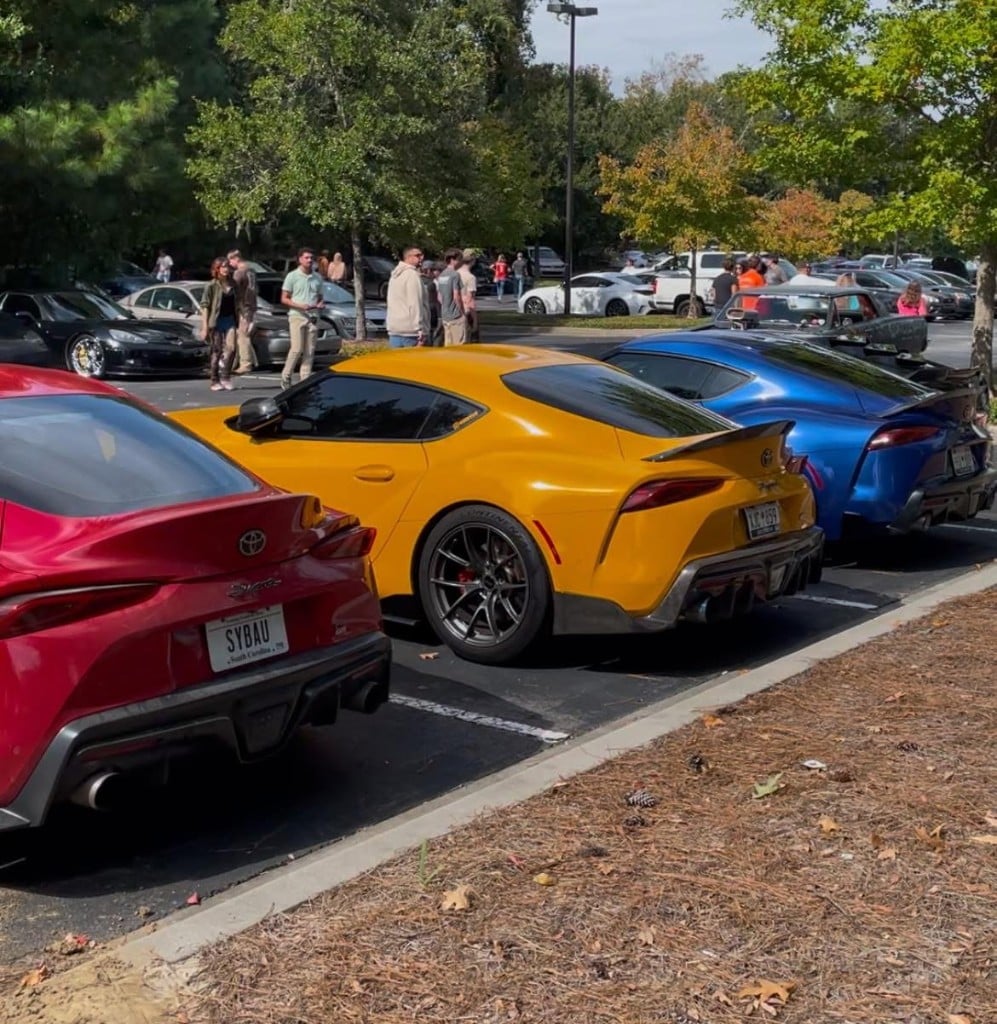
The Supra name has been bolted to a lot of different hardware over the last four decades. Strip away the nostalgia and the movie quotes, and what you're left with is a pretty simple idea: front-engine, rear-drive, straight-six, and a chassis that can take more power than Toyota officially gives it.
Early Days: Mk1 & Mk2 (A40/A50, A60)
The first Supras were essentially stretched Celicas with a straight-six. The Mk1 (late '70s) used Toyota's M-series SOHC inline-six and a longer wheelbase. It was more GT than sports car, comfortable, smooth, and not in a hurry.
The Mk2 (A60) is where things got more interesting. Toyota added a DOHC 5M-GE, electronic fuel injection, and TEMS (Toyota Electronic Modulated Suspension) on higher trims. For the early '80s, adaptive dampers and a proper multi-link style rear setup were serious hardware. It still carried some Celica DNA, but you could see Supra starting to become its own thing.
Stand-Alone Platform: Mk3 (A70)
With the Mk3, Supra finally split from Celica. Celica went FWD; Supra stayed RWD on a dedicated platform. The 7M-GE and turbo 7M-GTE (single CT26, air-to-air intercooler) gave the car real highway pace, and the chassis moved to double-wishbones all around.
On paper, it was a proper grand tourer: independent suspension, available LSD, ABS, and another round of TEMS. In reality, it also brought weight, and the 7M's head gasket issues are well-documented. Still, it set the template: straight-six, turbo option, tech-heavy chassis.
The Icon: Mk4 (A80)
The A80 is where Toyota went all-in. The 2JZ-GTE is an iron-block, aluminum-head inline-six with stout internals, sequential twin turbos, and a reputation for taking abuse. The chassis got shorter, stiffer, and lighter than the Mk3 despite more safety gear. Suspension stayed double-wishbone at all four corners, with big brakes and available torsen LSD on turbo models.
What makes the Mk4 so special technically isn't just the stock performance, it's the headroom. The engine block, crank, and general design were massively overbuilt for the factory power levels. With modern fueling and tuning, 600-800 hp builds are almost routine, and four-digit dyno sheets exist without turning the car into a science experiment.
Modern Era: Mk5 (A90/A91 GR Supra)
When the Supra badge came back in 2019, it did so on a shared platform with BMW. Underneath, it's a compact, stiff RWD chassis closely related to the Z4: aluminum-intensive structure, short wheelbase, wide track, and multi-link rear with adaptive dampers.
Under the hood is BMW's B58 3.0L single-turbo inline-six. It's aluminum, direct injected, and packed with modern tricks: variable valve timing and lift, water-to-air intercooling, and tight ECU control. It doesn't have the 2JZ's iron-block mythology, but it answers to a different brief, strong torque, good emissions numbers, and quick response with a single twin-scroll turbo.
On a back road or track, a stock Mk5 is simply a sharper tool than a stock Mk4. Chassis rigidity, braking, and electronics work together in ways a '90s car just can't match without serious upgrades. The trade-off is complexity: more software between your right foot and the rear tires, and an ECU that doesn't like being casually hacked.
How They Really Compare
- Engine philosophy: The Mk4's 2JZ-GTE is old-school overbuild with simple control systems; the Mk5's B58 is lighter, more efficient, and relies on software and sensors instead of sheer metal thickness.
- Chassis: Mk3 started the independent, tech-heavy trend. Mk4 refined it. Mk5 turns the stiffness and precision up again, but leans on electronics for fine-tuning instead of purely mechanical tuning.
- Modding: If you want to wrench in a garage and chase four-digit power, the Mk4 is still the ideal canvas. If you want a modern, warranty-backed car that can be made properly quick with bolt-ons and a tune, the Mk5 does that job better than most people admit.
What's Likely Next for Supra
Looking at where regulations and tech are headed, the next logical Supra evolution probably isn't a bigger turbo, it's electrification.
The most believable path is a hybridized inline-six: a smaller, efficient turbo engine with an integrated electric motor helping with torque fill and low-speed response. That setup lets Toyota keep the front-engine, rear-drive layout while meeting emissions and giving engineers more ways to shape the power curve.
Expect even more software in the loop: drive modes that meaningfully change how the car behaves, smarter traction management, and factory data logging that would have been race-team-only tech back in the Mk3 days.
Whether the Supra name ever jumps fully to an EV platform is an open question. It may eventually split: a hybrid GR Supra for the die-hards who still want combustion and a separate electric coupe carrying some of the styling and philosophy into a different powertrain era.
What hasn't really changed across all these generations is the core idea: a straight-six at the front, power out back, and a chassis that invites people to tinker, tune, and push further than the spec sheet suggests.
written by the redlightcam team
a person excited for a chance to own a supra one day..